IT Essentials · Intermediate
Computer Networks & Architecture
The engineering behind a network: layered architecture and protocol design, routing and switching internals, subnetting as arithmetic, redundancy, and the measurements that settle performance arguments.
IT Essentials program
- Lessons
- 4
- Study time
- 40m
- Level
- Intermediate
- Program
- IT Essentials
Sign in to open the lessons
4 lessons
Lessons, files and narration open after you sign in and buy the program. One payment opens every course in it.
Sign in to open a lesson. Buying the program opens every course and lesson in it, permanently.
About this course
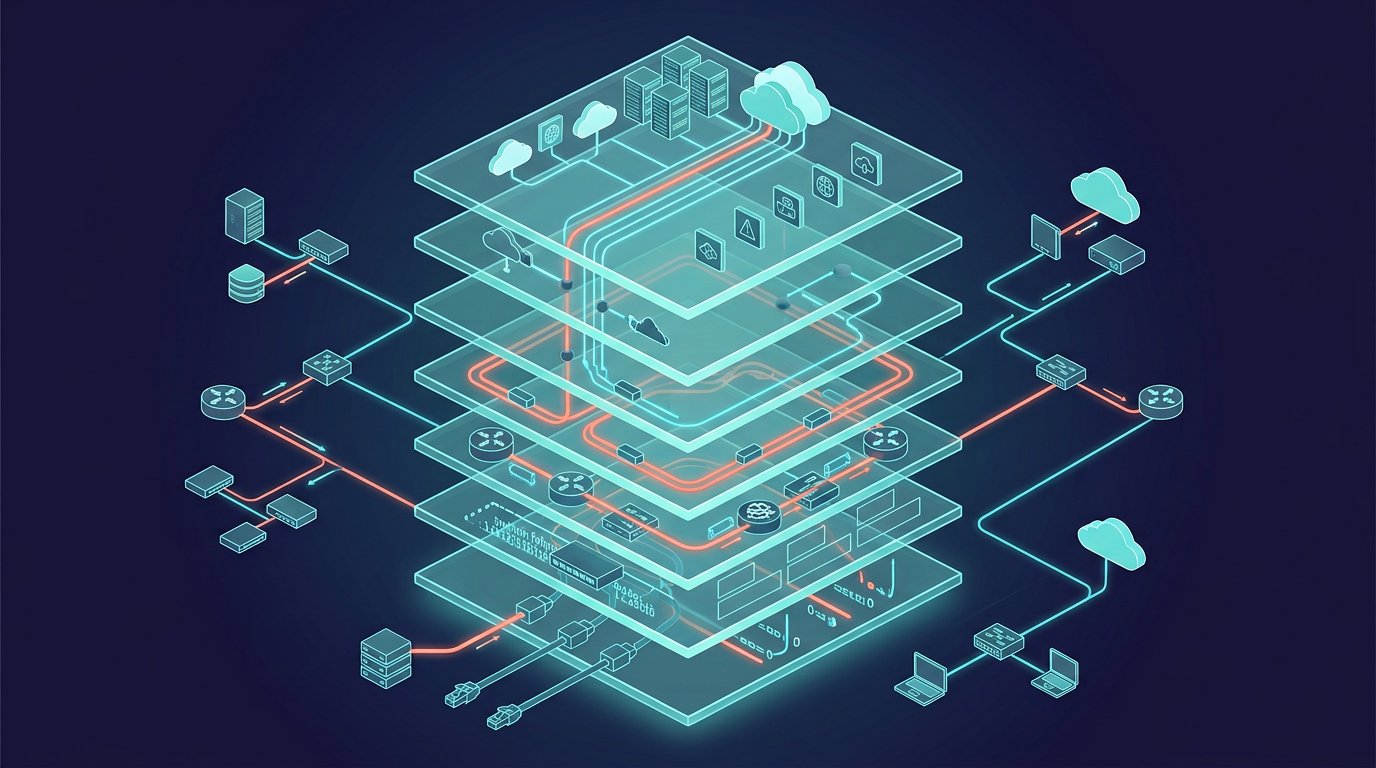
Layering is the decision that let the internet grow: each layer offers a service upward and uses the layers below without needing to know how they work. This course takes that abstraction apart — the layered architecture, how protocols are designed, and what a router and a switch actually do with a packet or a frame.
Then it becomes design work. Subnetting is taught as arithmetic you can do under pressure; segmentation and VLANs as a policy decision rather than a formula; redundancy as a plan for what happens when a piece fails; and performance as measurement — throughput, latency, jitter and loss — so arguments about a slow network end with evidence.
The project is a design document for a two-floor organisation: address plan, segmentation, redundancy and a capacity estimate with the assumptions written down.
Who this is for
- You already know what an IP address and a router are and want the engineering underneath.
- You are moving from IT support into network administration or design.
- You are preparing for certification or interviews that require real understanding rather than memorised commands.
Before you start
- Comfortable with IP addressing, DNS, ping and traceroute — Computer Networking covers that ground.
- Patience with binary and basic arithmetic; the subnetting lesson builds it from scratch.
- About five hours a week for two weeks.
Where it leads
- Cyber Security: Offense and Defense and Cloud Security both build on network behaviour.
- System Design & Architecture applies the same reasoning to application services.
- Network administration and design roles in banks, ISPs and large institutions reward exactly this document-driven approach.
Tools you will use
What you will build
- 1An annotated packet capture showing encapsulation through the layers
- 2A subnet plan for a site with several departments, with the arithmetic shown
- 3A segmentation policy using VLANs and access rules
- 4A redundancy plan stating what fails over and how long it takes
- 5A capacity estimate and a performance baseline for the design
Curriculum
2 modules · 4 lessons · 40m
Sign in to open each lesson
01 · How networks are built
Layers, protocol design, and what really happens inside a packet's journey.
1. The layered architecture of networks
Layering is the single design decision that made the internet grow: each layer offers a service to the layer above and uses the layers below without knowing how they work. This lesson covers the OSI and TCP/IP models properly — not as a diagram to memorise but as an engineering tool — and shows what the separation buys you: interchangeable technologies, independent security boundaries and interfaces that can be reasoned about one at a time.
2. Routing and switching internals
A router does not know the way; it knows one next hop at a time, chosen by the longest matching prefix in a table. A switch does not route at all; it learns which MAC addresses live on which ports and floods anything it does not know. This lesson covers forwarding decisions, the routing table, the protocols that fill it (OSPF, BGP), switching and VLANs, NAT in practice, and the MTU and fragmentation problems that produce the strangest bugs in production.
02 · Designing networks that behave
Subnetting as arithmetic, redundancy, quality of service, and the evidence that it works.
1. Subnetting, segmentation and redundancy
A network design is mostly two decisions repeated: how you slice the address space, and what happens when a piece fails. This lesson makes subnetting arithmetic routine — masks, usable ranges, host counts, VLSM planning — then covers segmentation as a security control, redundancy and the trade-off between availability and complexity, and capacity planning based on measured traffic rather than vendors' claims.
2. Network performance, monitoring and failure
The last lesson of the course is about evidence: how to measure a network so that arguments end, how throughput, latency, jitter and loss interact with TCP's own behaviour, how to monitor a network for the failures that matter, and how modern topologies — spine-and-leaf, SDN, CDNs and cloud networks — change the way performance is designed rather than repaired.
4 lessons, including the a network design document for a two-floor organisation: subnet plan, segmentation policy, redundancy plan and capacity estimate project. Sign in and buy the program to open them. Create an account to track progress and earn the certificate.
Taught by a working engineer
Kwame Mensah — Staff Engineer. Every lesson is written to be used, not just watched.
A verifiable certificate
Complete every lesson and you get a certificate with a code and QR that an employer can check in seconds.
Practice in the Code Lab
Write and run code in the browser while you learn, with your work saved to your own account.
Still have a question?
Email hello@codemasterghana.com or send a message from the contact page — we answer within two working days, in English or Twi.